
South Sudan
Country type
Main characteristics: medium-sized gold producer by African standards; gold production exclusively from artisanal and small-scale mining; no official statistics on gold production and trade
Gold production
-
Artisanal and small-scale mining
- Declared: none
- Non-declared: possibly around 5 tonnes per year
-
Industrial and large-scale mining: non-existent
Gold exports
- Declared: none
- Non-declared: very difficult to estimate, but possibly around 5 tonnes per year, according to one estimate
EITI member: no
Reports to UN Comtrade: no
Summary
Note: References for the information provided in the summary can be found in the following sections.
Gold mining in South Sudan is highly informal and illegal. South Sudanese authorities have so far failed to govern the sector effectively. Indeed, some observers and analysts have described South Sudan as a country with a kleptocratic political regime, where conflict and instability are widespread. As a result, there is little reliable information – and no official statistics – on the country’s gold production and trade.
According to the most plausible estimate of gold production in South Sudan SWISSAID was able to identify, i.e. approximately 5 tonnes per year, the country represents a medium-size gold producer by African standards. This production derives exclusively from artisanal and small-scale mining (ASM), which is performed informally, often under the control of armed groups, and using basic tools and equipment, leaving many miners exposed to exploitation and great health and security risks. The long civil war in South Sudan, which officially lasted from 2013 until 2018, but whose end has not brought real peace or fully eliminated violence, has impoverished the population and hindered the building of basic infrastructure such as paved roads. As a result, the conditions for the development of industrial mining are lacking. South Sudan is thought to have abundant mineral resources, but their geological mapping has yet to be achieved.
All the gold extracted in South Sudan is eventually exported outside formal channels. Smugglers, many of whom are reportedly foreigners, benefit from weak law enforcement and the complicity of some corrupt representatives of state authorities.There are indications that national and foreign armed groups are also involved in this traffic, which points to the use of South Sudanese gold for conflict financing.
Among the main countries of destination of South Sudanese gold identified by NGO reports and other such sources are Kenya, Uganda, and the United Arab Emirates (UAE). These last two countries are the only ones whose authorities have reported gold imports from South Sudan in recent years. The Emirati authorities, for instance, have reported imports of USD 20 million and USD 27 million from South Sudan in 2022 and 2023, respectively.
Finally, South Sudan became a transit hub for gold originating from Sudan after the onset of civil war in that country in 2023.
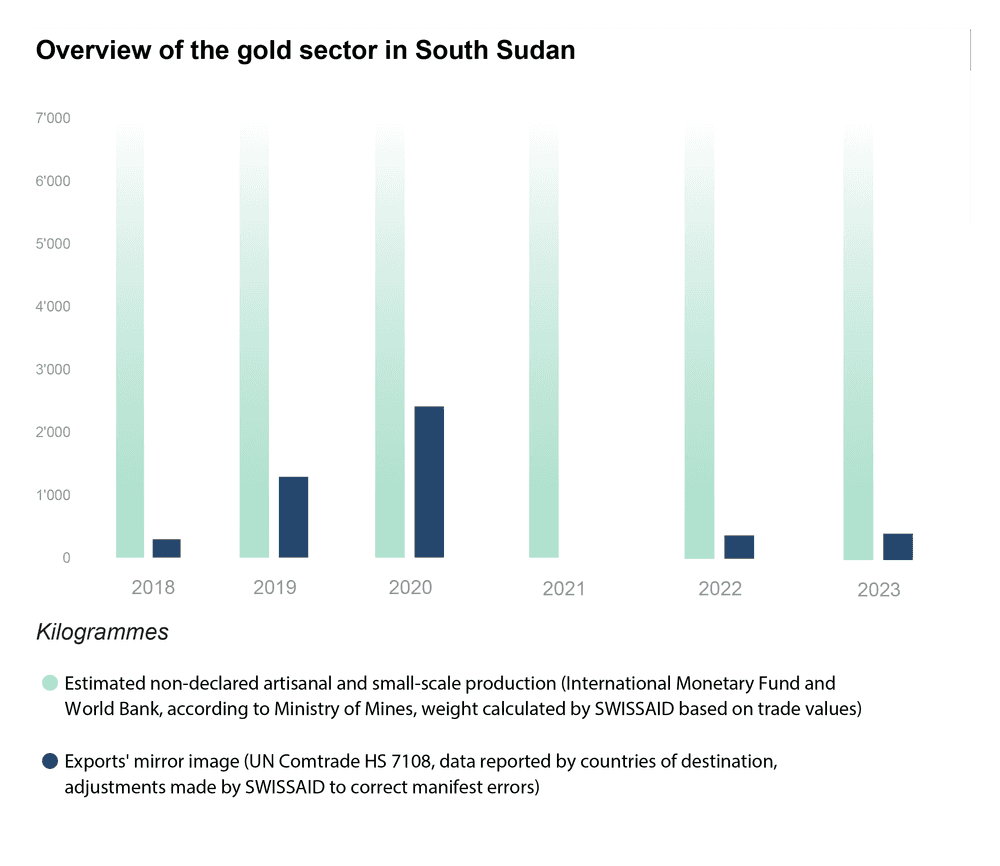
The lack of data on gold production and trade in South Sudan clearly hinders an analysis based on numbers. That said, what stands out in the graph above – and is corroborated by many of the sources mentioned in the following paragraphs – is that the gold mined in South Sudan is smuggled out of the country and only a small portion appears in statistics released by the countries of destination.
Gold production
To the best of SWISSAID’s knowledge, the South Sudanese authorities do not publish any statistics on gold production. The Bank of South Sudan (BoSS)’s annual reports and financial statements do not contain any data on mining (BoSS n.d.)1. The Ministry of Mining (MoM)’s website contains a page entitled “reports” (MoM n.d.), but it cannot be accessed. SWISSAID sent a request to obtain these reports, but the MoM has not replied. As for the National Bureau of Statistics (NBS), its website does not seem to contain any information on gold production – or mining in general, for that matter (NBS n.d.). Were South Sudan a member of the Extractive Industries Transparency Initiative (EITI), the country’s authorities would have to report publicly on mineral production on a yearly basis, but this is not the case.
The absence of official statistics on gold production in South Sudan is widely acknowledged, for instance implicitly by the MoM itself when its undersecretary declared in 2021 that there was no formal mining in South Sudan (Radio Tamazuj 2021). Most recent NGO reports on gold in South Sudan stress that this lack of statistics on production and trade represents a challenge for understanding the sector (see, e.g. ISPR & CSCNR 2025: 10; GI-TOC 2023: 7). This absence of official statistics should be viewed as more than simply the result of neglect by the South Sudanese authorities. Rather, it is an expression of the informality, opacity and secretiveness characterising South Sudanese gold mining, which “may take place on an ad hoc basis for the benefit of individual members or small groups, rather than organizations as a whole” (GI-TOC 2023: 12). As the NGO The Sentry put it: “Some government officials, their relatives, and their closed associates have fostered a weak regulatory environment susceptible of exploitation” (The Sentry 2020a: 1).
In a report published in 2023, the Global Initiative against Transnational Organized Crime (GI-TOC), advances that, even though official statistics are unavailable, the South Sudanese gold sector could be worth millions of U.S. dollars (GI-TOC 2023: 7). Gold mining has the potential for increasing the stability of a national economy that primarily relies on the oil sector, which is much more volatile and was recently affected by export disruptions linked to the ongoing war in Sudan (UN Security Council 2025: 31 (164); World Bank 2024: 5).
Notwithstanding the existence of a comprehensive legal framework, including a Mining Act (2012), mining in South Sudan is poorly regulated and enforcement is weak (World Bank 2024: 51; ISPR & CSCNR 2025: 6; see also Radio Tamazuj 2025). The sector is affected by poor governance and corruption, which are compounded by the difficult coexistence of national agencies, local governments, and traditional authorities (Eye Radio 2025)2. According to the above-mentioned Mining Act, only the national government is entitled to grant exploration and mining permits. Yet, deals struck between companies and local governments have been documented (UN Security Council 2025: 32 (174)). More generally, existing rules are either not enforced or not reasonable3. As a result, most mining activities occur informally and without authorisation (Enough Project 2020: 3–4). In brief, South Sudan’s gold reserves are largely exploited through a system characterised by corruption, impunity, conflict, and instability (GI-TOC 2023: 29).
Despite the very high purity of the gold mined in South Sudan4, prices paid for the yellow metal within the country remain low, which has a lot to do with the volatility of the country’s currency, the South Sudanese pound, and unattractive official exchange rates. This makes the black market and barter particularly attractive and creates the perfect condition for the exploitation of miners (GI-TOC 2021: 19, 21–22). The national government’s attempts to purchase gold at fixed prices, in a bid to stimulate the country’s economy, have proven unsuccessful so far, mainly because of the insufficient amounts of money allocated (Radio Tamazuj 2025). Those attempts have even backfired, inducing an increase in the prices offered by foreign traders on the black market (GI-TOC 2023: 16; UN Security Council 2025: 32 (170)).
Industrial gold production
To the best of SWISSAID’s knowledge, there isn’t any industrial gold production in South Sudan. The MoM confirmed to SWISSAID in 2023 that industrial gold mining was still at the exploration stage5. There seems to be potential for industrial mining in South Sudan (Cordaid 2016: 14; UNDP 2023: 271; Machame Mines 2025), but it remains untapped so far. A key problem is that the country’s mineral deposits have not yet been properly mapped (Enough Project 2020: 2; Radio Tamazuj 2025). But things may be changing: the MoM was attributed a budget of USD 65 million in October 2023 to conduct a geological survey and minerals mapping in parts of the country (One Citizen Daily 2025), and signed a memorandum of understanding with South Africa’s Department of Mineral Resources and Energy in February 2024 for cooperation on exploration, knowledge transfer and capacity building in the mining sector (One Citizen Daily 2025).
The MoM has also been trying to lure foreign investors for more than a decade (NPR 2013; Mining Review Africa 2022; Energy, Capital & Power 2024), but it seems this strategy has yet to pay off in the gold mining sector. It should be stressed that war in South Sudan has lasted decades and had dire consequences for the country. Among other things, it has hindered the construction of basic infrastructure, such as paved roads, which are essential for large-scale mining logistics (Enough Project 2020: 2; The Sentry 2020a: 9). In addition, the nature of the political regime, described by many observers as violent and kleptocratic, has severely limited exploration activities and dissuaded international mining companies from investing in the country (The Sentry 2020a: 17). In brief, the unstable and insecure context stands in the way of South Sudan’s economic and industial development, including in gold mining.
Artisanal and small-scale gold production
Due to the aforementioned factors, exploration and prospecting have long been conducted exclusively by small-scale operators (Enough Project 2020:2). As a result, gold mining in South Sudan remains mostly artisanal to this day (UN Security Council 2025: 31 (166)).
Artisanal gold mining in South Sudan dates back to colonial times. Most of the gold mining sites are located in two states: Eastern Equatoria and Central Equatoria (Cordaid 2016: 23; Enough Project 2020: 1). The sector employs tens of thousands of workers and indirectly benefits many more people (ISPR & CSCNR 2025: 15). Extraction techniques are described as particularly rudimentary: “Miners (are) lacking even the most basic equipment. For example, no mechanization or chemicals (including mercury) is used to process artisanally mined gold” (GI-TOC 2021: 7).
Traditionally, gold mining in South Sudan is practised by ordinary people as a supplement to farming or cattle rearing (Cordaid 2016: 29). In recent years, however, it has become the sole source of livelihood for many, because of climate change’s negative impact on agriculture and rising poverty, more generally (InfoNile 2024). As a matter of fact, South Sudan is experiencing a gold rush: many are attracted to gold mining by the perspective of escaping poverty, and willing to take the risk of being arrested, or even dying in a pit, if that is what it takes (Eye Radio 2025; VoA 2017).
ASM in South Sudan “is controlled by the states”, the MoM explained to SWISSAID two years ago6. In a recent report, the UN Panel of Experts on South Sudan notes that “State authorities, including in Eastern Equatoria State and Western Bahr el-Ghazal State, have relied on this provision to operate their own mining sectors that are largely independent of national authorities” (UN Security Council 2025: 31). This situation goes a long way to explaining why the ASM sector is broken up into a multitude of subsectors that function without oversight by the national government and are often controlled by local armed groups (UN Security Council 2025: 31 (166, 168)). Disputes over land where mining sites are located arise easily, because these sites are not divided into plots and land is owned communally (Cordaid 2016: 31). This creates tension within and among local communities (UNDP 2023: 273–274), and represents a fertile ground for the militarisation of mining (GI-TOC 2023: 10).
Armed groups such as the South Sudan People’s Defence Force (SSPDF), the South Sudan People’s Liberation Army in Opposition (SPLA-IO), the National Salvation Front (NAS), and the National Security Service (NSS)7 (The Sentry 2020a: 13–18) are involved in gold mining and take control of land where mining sites are located to enrich themselves, which they may do by requiring to be given a share of production or paid informal taxes (The Sentry 2020b: 2). In some cases, the members of these armed groups also work as miners to compensate for the low salaries they receive as soldiers (GI-TOC 2023: 11-12 ; UN Security Council 2025: 31 (168)). The fight for control over gold mining sites regularly triggers violent clashes between armed groups – state and non-state – but it can also be conducive to de facto peace, given these groups’ common goal of maximising profits from gold mining (GI-TOC 2023: 13).
In recent years, some small-scale mining concessions were granted in the Gorom area near Juba, Kapoeta, and Western Bahr el Ghazal, but it is difficult to know if the operations there have reached the production stage or are still exploring (GI-TOC 2021: 9 ; GI-TOC 2023: 9-10). There are indications that foreign actors, especially Chinese, are also involved in the business (Cordaid 2016: 38–39; The Sentry 2020a: 5), even though in principle licenses can only be granted to South Sudanese citizens.
Given the context described above, it is not surprising that estimates of total gold production in South Sudan are rare and arguably unreliable. A report published in 2020 as part of the Enough Project indicates that between 1 and 2 tonnes of gold is mined every month (Enough Project 2020: 2), which corresponds to between 12 and 24 tonnes every year. Another, earlier report mentions an average of daily gold production per miner of 1 gram (Cordaid 2016: 23), which it attributes to the World Bank8. The same report also advances that at least 60,000 miners are involved in gold mining in South Sudan, citing the MoM’s predecessor, the Ministry of Petroleum and Mining (Cordaid 2016: 23). Assuming both figures are realistic, this would result in an annual gold production of more than 22 tonnes every year. An expert on South Sudan consulted by SWISSAID9 considers these figures as excessively high. He noted that 24 tonnes of gold would be worth almost USD 1 billion, which is more than the entire petroleum production of South Sudan, a country known for its dependence on revenue from the black oil.
SWISSAID therefore decided to rely on another figure for its analysis, namely 5 tonnes a year. This weight is based on the estimated value of the gold that was smuggled out of South Sudan in 2022, according to the International Monetary Fund and the World Bank, namely USD 270 million (USD 150 million to Uganda and USD 120 million to Dubai)10. SWISSAID obtained this information from South Sudan’s MoM11 and could not locate its original source, but a representative of the MoM claimed in an email to SWISSAID that the figure of 5 tonnes per year was “more realistic” than the others mentioned above12.
Though quantifying it remains a challenge, gold production in South Sudan is very substantial – and it is likely to have increased in the last two years due to the surge of the international market price for the yellow metal.
Gold imports
As with production, there are no statistics available on the gold trade in South Sudan. South Sudanese authorities do not report to UN Comtrade, the United Nations’ database on international trade. A category named “External Sector (Trade)” can be found on the National Bureau of Statistics (NBS)’s website (NBS n.d.), but it does not contain any document. The NBS has also published annual reports and statistical yearbooks in the past, but those available on its website are all obsolete (10 years old or more) (NBS n.d.). The Ministry of Trade and Industry (MoTI)’s website indicates that it has both a Directorate of External Trade and Industry and a Directorate of Planning, Research and Statistics (MoTI n.d.), but SWISSAID could not identify any document released by the MoTI that would contain statistics on external trade. In the Merchandise and Trade Statistics section of the African Development Bank (AFDB)’s South Sudan Data Portal (AFDB n.d.), which uses NBS data, one entry concerns gold, but it is not reliable, so SWISSAID decided to disregard it13.
Illegal gold imports
South Sudan, with its porous borders, weak governance, and limited mining sector regulation, often acts as a transit country for regional gold traffic. In a recent report, the UN Panel of Experts on South Sudan revealed that after the onset of civil war in Sudan, gold had started entering South Sudan from that country. This smuggled gold does not stay in South Sudan, but is shipped by air to the UAE, and there are indications that the Sudanese Rapid Support Forces (RSF) as well as the security forces of Uganda are implicated (UN Security Council 2025: 33). In brief, South Sudan currently functions as a transit country for smuggled gold from Sudan. However, there is no information on the volumes of the precious metal involved.
Another source advances that smuggled gold from the Central African Republic could be transiting through South Sudan, among other countries (Interpol and ENACT 2021: 19). Here too, information on volumes is missing.
Gold exports
In South Sudan, gold exports take place outside formal channels. In a report published in 2021, GI-TOC stated that “the government has only granted one mineral dealing licence since 2019, few export certificates have been issued and no gold exports are recorded” (GI-TOC 2021: 27). Two years ago, in an exchange of emails with SWISSAID, the Ministry of Mining (MoM) confirmed the absence of officially declared gold exports14.
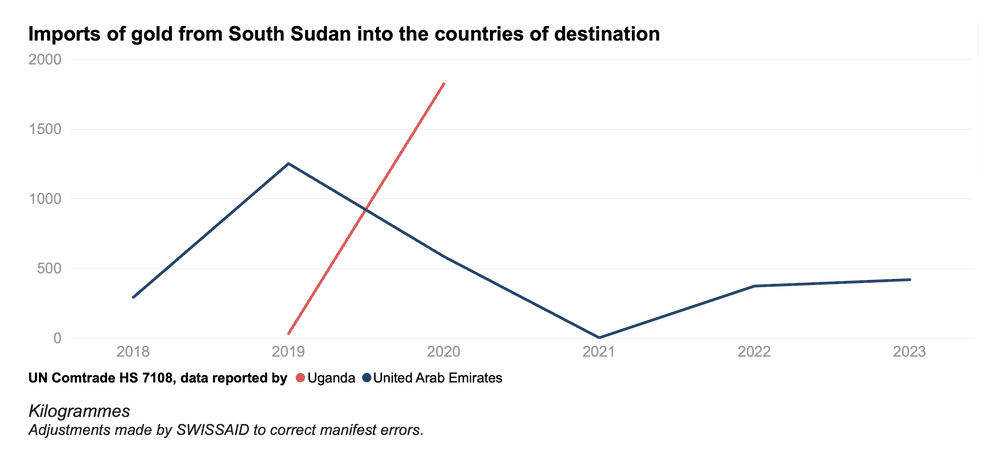
Given the absence of statistics on gold exports from South Sudan, SWISSAID could only display the official countries of destination using data on gold imports from South Sudan reported by the authorities of the other countries to UN Comtrade. That dataset shows that the Emirati authorities reported gold imports from South Sudan of 290 kg in 2018, 1.3 tonnes in 2019 and between 580 kg and 417 kg in 2020–202315, and the Ugandan authorities reported almost 2 tonnes in 2020. The UAE and Uganda were therefore the two main countries of destination in that period, according to official statistics. At the time of writing this report, no country had reported gold imports from South Sudan for the year 2024 – and the UAE had already reported to UN Comtrade, which means that the Emirati authorities do not acknowledge any gold imports from South Sudan.
However, some known or suspected countries of destination for gold smuggled out of South Sudan, including Kenya and China (see below), do not appear in the graphs above, because the authorities of these countries did not report any gold imports from South Sudan to UN Comtrade. This, and the fact that gold exports in South Sudan take place outside formal channels, as mentioned above, means that those graphs represent only part of reality.
Illegal gold exports
It is very difficult to estimate the amount of gold that is smuggled out of South Sudan each year. MoM seems incapable of providing any figure16. But there are good reasons to believe that millions of U.S. dollars’ worth of gold exits South Sudan without a trace every year. The involvement of corrupt political elites, law enforcement bodies, armed groups, and foreign actors in the smuggling of gold out of South Sudan (GI-TOC 2023: 12) makes tracing and quantifying gold flowsparticularly challenging.
In a recent press article, a representative of MoM is quoted as having said that gold smuggling in South Sudan owes much to the porosity of borders, weak border controls, and uncompetitive government pricing for the precious metal: “Businessmen, both South Sudanese and foreigners, trade in gold. The government may set a price, but a trader offers more, so miners sell to them instead”, he explained (Radio Tamazuj 2025).
According to GI-TOC (2023: 15) and the UN Panel of Experts on South Sudan (UN Security Council 2025: 32–33), illicit gold flows from South Sudan follow three main routes: to Dubai (UAE) via Juba airport, and to Kenya and Ugandathrough both official and unofficial land border crossing points. Before the onset of civil war in Sudan (see SWISSAID's country profile Sudan), this country was also a destination of gold smuggled out of South Sudan (Enough Project 2020: 5; GI-TOC 2021: 30 ; UN Security Council 2023: 36). However, since then, the direction of gold flows between the two countries has inverted (see above, Illegal gold imports).
There is evidence that gold smuggled from South Sudan into Kenya eventually reaches Dubai, where it is labelled as Kenyan gold (Eye Radio 2025) (see also SWISSAID’s country profile Kenya). In a report dated 2019, the Canadian NGO Impact pointed to the role of India as the final destination for some of the gold from South Sudan that is smuggled via Kenya. According to the NGO, this gold is “often exported as ‘gold sand’ (small, grain-like beads) and easily transported by smugglers on direct flights to Mumbai” (Impact 2019: 27).
Regarding Uganda’s role as a transit country, it is possible that South Sudanese gold is reclassified as Ugandan when reexported from that country. This would partly explain the excessively high figures on gold exports out of Uganda (compared to their mirror image, namely gold imports from Uganda reported by the other countries, and domestic gold production in Uganda) (UN Security Council 2025: 32 (172)).
Finally, there are indications that gold could be flowing from South Sudan to China. Several sources mention the presence of Chinese nationals in the South Sudanese gold sector, and describe them as smugglers (La Tribune 2017), traders (Enough Project 2020: 5), or companies involved in smuggling (InfoNile 2024). According to GI-TOC, “Chinese nationals are reported to be the biggest buyers in Juba”, and work directly with government officials, which facilitates the smuggling of gold out of South Sudan by air, most probably directly to China (GI-TOC 2021: 29–31, 43).
- These reports are also available only until 2020.↩
- Interferences between the States’ authorities and national institutions and the detrimental effect on the development of the gold sector were also confirmed by an expert (who requested anonymity) SWISSAID contacted in November 2023.↩
- For instance, applying for a mining permit involves an overly complicated and expensive procedure for artisanal miners, most of whom have no choice but to operate without one. As a result, they are presented and treated as criminals by the MoM and other state authorities (Cordaid 2016: 44; Enough Project 2020: 3; The Sentry 2021: 11).↩
- A study conducted in 2016 revealed that gold in South Sudan, unlike in most other parts of world, was sufficiently coarse-grained to be picked by hand without the use of mercury or other chemicals (Cordaid 2016: 10). Whether or not this is still the case today is not known.↩
- MoM’s response to SWISSAID, 29 November 2023. SWISSAID has not found any evidence that the situation may have changed since.↩
- MoM’s response to SWISSAID, 17 November 2023.↩
- The presence of foreign armed forces from the Central African Republic and Uganda has also been reported (GI-TOC 2023: 13).↩
- The report doesn’t give any reference for that source and SWISSAID has not been able to find it. In another passage, the authors of the report also claim that “it can be assumed that miners extract an average of 1–2 grams of minerals (mainly gold) a day”, but do not cite any source (Cordaid 2016: 10).↩
- SWISSAID’s interview with an expert on mining in South Sudan, 3 November 2023. The expert requested anonymity.↩
- It is reasonable to assume that South Sudan’s entire gold production is exported – or, in this case, smuggled out of the country – because there is no sizeable domestic market for the yellow metal. Exports possibly also include gold that has transited through – in this case, been smuggled into – South Sudan on its way to global trading hubs. But as there is no data on gold imports, the estimate of 5 tonnes can, at least for practical purposes, be used for not only gold smuggling but also gold production.↩
- MoM’s response to SWISSAID, 29 November 2023.↩
- MoM’s response to SWISSAID, 6 December 2023.↩
- The online database indicates that 26.5 tonnes of gold powder (labelled HS 71081100) have been imported into South Sudan from China between 2019 and 2024. However, the associated trade value is only USD 12,500, which results in an entirely unrealistic price for gold. So SWISSAID did not investigate further. Furthermore, since China is the world’s largest gold consumer, it is much more likely that the precious metal would be exported from South Sudan to China than the other way around.↩
- Email exchange between SWISSAID and MoM, November 2023.↩
- There is a problem with the volumes reported to UN Comtrade by the Emirati authorities for 2018 and 2023: the trade value to weight ratios for those years result in unrealistic gold prices. SWISSAID decided to correct the reported weights based on the reported trade values, because the latter are more constant.↩
- Email exchange between SWISSAID and MoM, November 2023.↩